
Buying a mop making machine becomes much easier when the factory, raw materials and finished mop are defined before the quotation. This guide is for manufacturers preparing a loop or wet mop project and answers one practical question: what should you prepare before asking a supplier to confirm the machine? By the end, you should have a short requirement sheet covering the product sample, factory space, incoming material, mop cap, utilities, labour and acceptance test.
Prepare these seven items first
- An approved finished mop sample or dimensioned drawing
- A target output stated per hour or per shift
- A measured machine area with loading and maintenance clearance
- The final local voltage, phase, frequency and other utilities
- The intended mop yarn and its supply form
- The plastic cap or socket sample and the planned supply route
- An operator and a written sample-acceptance method
1. Start with the finished mop, not the machine name
Send a clear product photo, the finished length and width, target weight, yarn or strip material, cap style and any required stitching or band. If possible, keep one approved physical sample as the reference. “Mop machine” can describe different processes, so a supplier cannot confirm feeding, tooling or assembly from that phrase alone.
State the required accepted output with a time basis. Pieces per hour and pieces per ten-hour shift are different purchasing requirements. Also define what counts as an accepted piece, because output without an agreed product and quality limit is not a reliable comparison.
2. Measure the factory area and the delivery route
The project notes supplied for this article use around 10 m³ as an early space-planning reference and describe a wooden case of approximately 2 × 2 × 2 m, equal to 8 m³. These figures are useful for an initial check, but cubic volume does not define a workable installation. The final plan must use the configured machine footprint and allow space to load material, remove finished mops, open guards, reach service points and move safely around the equipment.
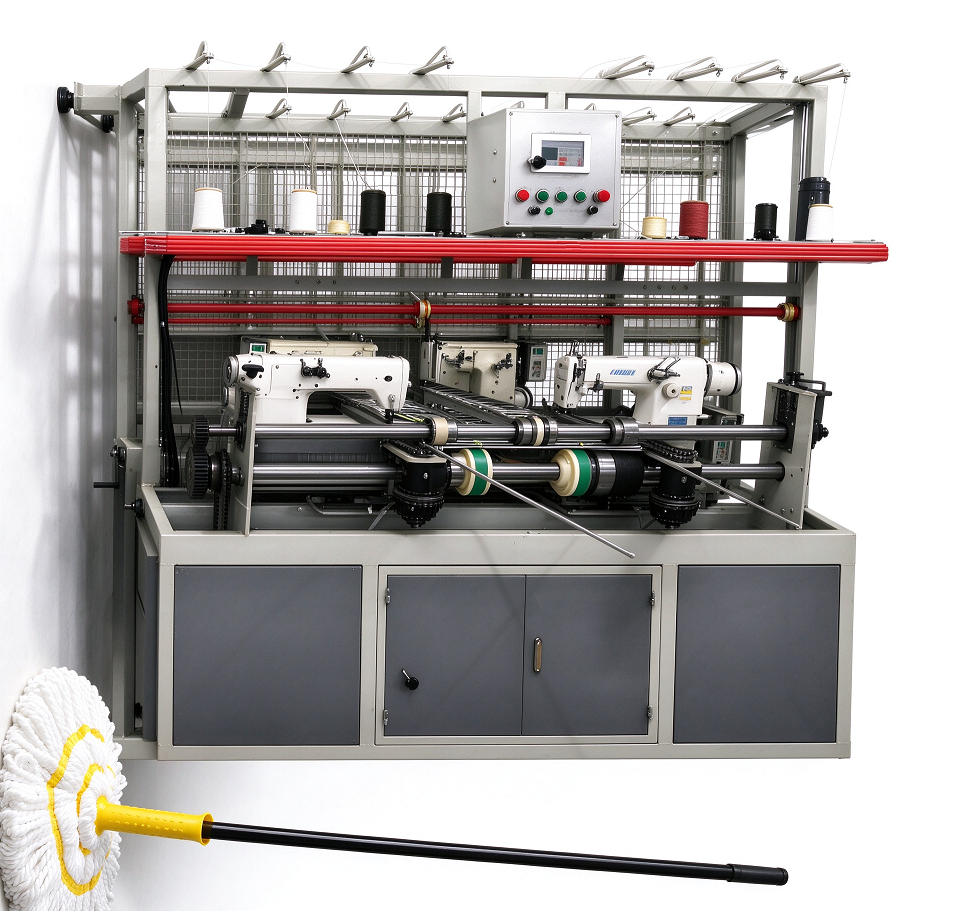
Before shipment, compare the packing list with the loading door, corridor, lift and unloading equipment. Ask whether the machine ships as one case or several pieces and whether any part must be removed for entry. Confirm final crate dimensions and weights in the shipping documents; the reference above is not a substitute for the actual packing list.
3. Decide how the mop yarn will be supplied
You can source suitable mop yarn in the local market or discuss supply from China. The project notes give a planning reference of USD 1.16 per kg with a 100 kg minimum order for standard material. Treat this as a reference for the next quotation, not a permanent delivered price. Confirm yarn grade, composition, colour, yarn count or strip width, packing form, moisture condition, freight and the date for which the price is valid.
Send representative production material for the trial. A machine run with a different yarn may not prove stable feeding or the finished appearance of your intended mop. Record the batch used during the test so the result can be repeated after installation.
4. Prepare the mop cap or socket sample
Decide whether you will buy standard plastic caps or inject them in-house. Send a physical cap sample together with the finished mop sample. The supplier can then review the fit and, when needed, quote a matching mould separately. Record the cap dimensions, resin or material specification, critical connection points and the pull or fit check used by your quality team.
Do not approve tooling from a photo alone when the cap controls machine feeding or final assembly. A sample and drawing make it possible to identify orientation, tolerance and contact surfaces before the machine configuration is frozen.
5. Confirm utilities and operator responsibilities
Provide the factory voltage, phase, frequency and grounding standard. Ask the quotation to list the connected electrical load and any compressed-air requirement for the selected configuration. Also confirm cable, plug, transformer, air-treatment and exhaust responsibilities before shipment.
The supplied project note describes an automatic machine that normally needs one operator. Confirm what that person actually does: load yarn and caps, monitor the process, remove finished mops, inspect samples and handle stoppages. Material preparation, carton packing and maintenance may sit outside that one-operator statement, so compare staffing on the same process boundary.
| Planning item | Reference available now | What must be confirmed for your order |
|---|---|---|
| Factory space | Around 10 m³ is stated in the project notes | Final footprint, working clearances and material flow |
| Wooden case | Approx. 2 × 2 × 2 m, or 8 m³ | Actual crate count, dimensions, weight and unloading route |
| Mop yarn | Local sourcing or China supply; USD 1.16/kg and 100 kg MOQ as a planning reference | Grade, colour, packing, current price, freight and trial batch |
| Mop cap | Standard purchase or buyer’s own injection | Physical sample, drawing, feeding fit and any mould quotation |
| Labour | One operator is described for normal automatic operation | Exact tasks plus separate preparation, inspection and packing work |
| Utilities | Not fixed in the supplied notes | Voltage, phase, frequency, connected load and compressed air |
6. Plan the trial and acceptance evidence
- Run the intended yarn and cap rather than substitute material.
- Record settings, test duration, accepted pieces, rejects and stoppages.
- Measure finished length, width and weight against the approved sample.
- Inspect cap fit, yarn alignment, bands, stitching and finished appearance as applicable.
- Witness guard, emergency-stop and safe-reset behaviour under a controlled test.
- List training, installation guidance, spare parts, consumables and warranty boundaries in writing.
Frequently asked questions
Is 10 m³ always enough for a mop making machine?
No. It is an early reference from the supplied project notes. Use the final footprint and add loading, unloading, guard-opening, operator and maintenance clearances before approving the layout.
Can I use mop yarn from my local market?
Yes, local sourcing can be considered. Send representative material for a machine trial and document its grade and supply form. China supply can also be discussed; reconfirm the current specification, price, MOQ and freight in the quotation.
What should I send for the plastic mop cap?
Send a physical cap and, if available, a dimensioned drawing. State whether you will buy the cap or inject it yourself. This lets the supplier review machine feeding and quote separate mould work when required.
Does one operator cover the whole production line?
The supplied note says one worker can normally operate the automatic machine. Confirm whether yarn preparation, quality inspection, finished-product removal, packing and routine maintenance are included before using that figure in a labour plan.
Turn the checklist into a machine-ready RFQ
A useful RFQ contains an approved mop and cap sample, dimensions, material, time-based output target, factory utilities, measured layout and acceptance method. With those inputs, the supplier can recommend a configuration and clearly mark what still needs a trial or written confirmation.