
A roller brush machine should be selected from the finished brush geometry, core material and filament preparation process. For circular pipeline-pig brushes, start with the core diameter, finished outside diameter, brush width and free bristle length, then prove drilling and tuft retention on the actual polyurethane. A catalogue roller-brush model is not automatically suitable for every circular brush from 4 to 56 inches. This guide uses an anonymised buyer inquiry to explain how to define the tooling, materials, supporting equipment and acceptance trial before ordering a complete brush manufacturing solution.
A real inquiry: making circular pipeline-pig brushes in-house
The buyer wanted finished circular cleaning brushes for oil and gas pipelines, starting from undrilled PUR cores with a hardness of 90–95 Shore A. The main requested bristle material was high-carbon steel wire described as “springy”; nylon or other plastic filament was needed less often for internally coated pipelines. The buyer had neither filament stock nor preparation equipment, so a machine-only quotation would leave important production steps unresolved.
| Buyer requirement | What must be defined for the quotation |
|---|---|
| Brush diameters: 4–56 inches | About 101.6–1,422.4 mm. Identify whether each dimension is finished brush OD or core OD; list the actual designs and widths. |
| PUR core: 90–95 Shore A | Confirm wall thickness, bore, clamping surfaces, batch condition and dimensional tolerances on representative cores. |
| High-carbon steel wire: 0.5–0.7 mm | Confirm the steel grade and elastic properties, then define straightness, cut length, packing form, end condition and the compatible feeding and anchoring method. |
| Tuft diameter: 6–8 mm | Agree the finished tuft and hole definitions, hole pattern, spacing and retention test. |
| Free bristle lengths: 60, 90 and 140 mm | Separate exposed bristle length from prepared wire length. Longer or shorter designs need a separate feasibility check. |
| Undrilled cores and no material preparation line | Include drilling, filament supply, anchoring consumables, preparation, finishing, tooling, inspection, commissioning and training. |
Roller brush machines and circular brush machines need different fixtures
A cylindrical roller is normally defined by its body diameter and working length. A circular pipeline-pig brush also needs its ring or disc geometry, bore, width and access angle specified. These differences affect the clamping method, rotation, drilling approach and clearance around the tufting head. The machine configuration must be selected from drawings and physical cores rather than the phrase “circular brush machine.”
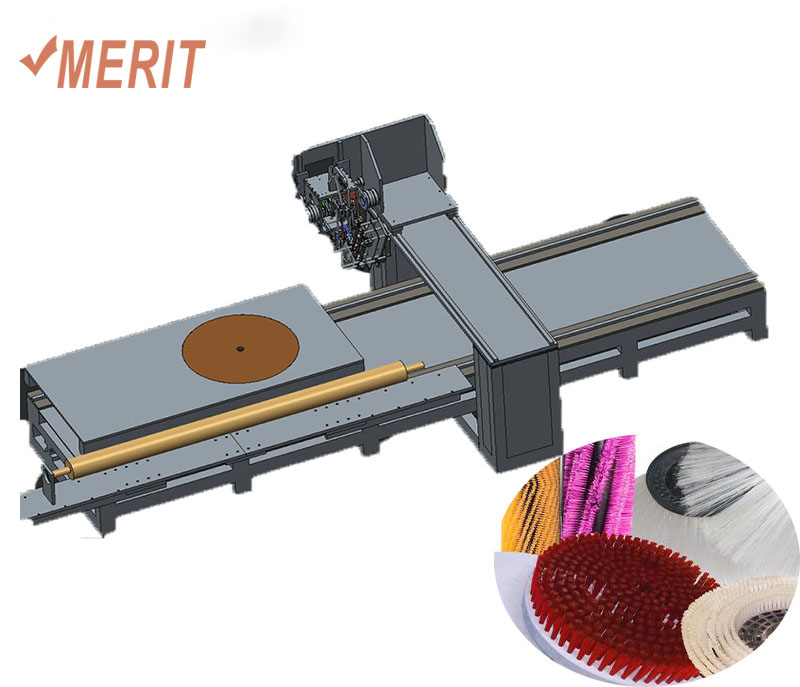
Existing Merit Factory product pages give a useful starting point for comparing machine families. Review the WXL 02 roller brush drilling and tufting machine, the MTRD1.5M roller-and-disc model and the MTD70 disc brush machine. Their catalogue descriptions do not prove the complete pipeline-pig application described here; a project-specific configuration and actual-material trial are still required.
First resolve core diameter, finished diameter and bristle length
One reference discussed with the buyer had a finished brush OD of 1,420 mm and a core OD of 1,140 mm. For an idealised radial brush, the difference gives a free radial bristle length of (1,420 − 1,140) ÷ 2 = 140 mm. This checks the drawing terminology; it does not establish the machine travel, clearance or finished-brush tolerance.
That same calculation explains why “all brush sizes” is not enough for an offer. A large core with short bristles and a small core with long bristles may have similar finished diameters but need different fixtures and head clearances. Provide a dimensioned design matrix, including the smallest and largest core, brush width, bore and longest bristle, so the supplier can identify changeover tooling and designs outside the proposed configuration.
Pre-cut carbon steel wire is a separate preparation decision
The conversation confirmed pre-cut carbon steel filament for the proposed process. The buyer therefore needed to distinguish ready-to-feed straight wire from wire supplied on coils. If coil stock will be purchased, straightening, cutting and handling equipment must be separately selected and listed. Do not assume that the tufting machine also prepares wire from a coil.
The initial discussion used 140 mm as the free bristle-length basis. A longer requirement changes the feeding and machine-clearance assumptions and may change the quotation. Prepared wire length must also account for the agreed insertion and anchoring method. It cannot be calculated from exposed length alone without knowing whether the tuft is folded, how the anchor is formed and how much finishing allowance is required.
Prove drilling and tuft retention on the actual PUR core
The buyer asked about an insertion depth of 5–10 mm; approximately 8 mm was discussed, explicitly subject to the sample. Treat it as a trial starting point rather than a universal setting. Core wall thickness, hole diameter, material hardness, wire bundle, anchor and hole spacing must work together.
The buyer planned to send PUR cores in several sizes. Test representative designs before the order, including difficult combinations of small or large core, longest bristle and thickest wire. A video of steel tufting into a different brush body is useful for understanding the process, but does not demonstrate retention in this PUR core. Agree a test on the actual core and intended filament.
- Record drilling and insertion settings against each approved sample.
- Inspect hole position, depth, edge condition and the core after drilling and tufting.
- Define a repeatable tuft-retention test, sampling quantity and acceptance threshold in writing.
- Keep the accepted brush, material identification and test record as the production reference.
Specify a complete line, including what is outside the machine
Because this buyer was starting without filament materials or preparation equipment, the supply scope needed to cover the route from an undrilled PUR core to a finished, inspected brush. Ask the supplier to identify each item as included, optional, buyer-supplied or subject to a material trial.
- Compatible carbon steel and nylon/plastic filament specifications, supply form and storage or handling instructions.
- Anchoring consumables and the compatible tuft-locking method, with a demonstration on the actual core.
- Core fixtures, drilling tools, feeding tooling, changeover parts and any required wire preparation equipment.
- Finishing or trimming equipment where required by the drawing, plus inspection gauges and retention-test equipment.
- Commissioning, operator and maintenance training, documentation, spare parts and the agreed trial materials.
For internally coated pipelines, the buyer requested nylon or plastic rather than the principal carbon steel configuration. Keep the two material routes separate in the specification and trial. Compatibility with the pipeline coating remains a decision for the brush designer and pipeline operator; a tufting demonstration alone does not prove coating safety or cleaning performance.
Agree performance and acceptance criteria before placing the order
Output should be measured on an agreed brush design, not quoted only as holes per second. A complete cycle includes loading, drilling, tufting, unloading and any finishing or inspection assigned to that operator. Agree the hole count, filament, bristle length, fixture quantity, rejected-part treatment and time basis. The supplied inquiry does not establish a validated production rate.
- Run the agreed range of PUR-core samples using the specified filament and anchors.
- Measure finished OD, width, bristle length, hole pattern and retention against the agreed drawing and test method.
- Record actual cycle time and changeover time on the approved sample set.
- Check the supplied guarding, emergency stop, operating instructions and utility requirements during the trial.
- Reconcile the demonstrated process with the written supply list and sign the sample and acceptance record.
Frequently asked questions
Can one roller brush machine make every 4–56 inch circular brush?
That range is a buyer requirement, not a confirmed standard-machine capacity. Confirm core and finished diameters, width, bore, bristle length, material and fixture access for each design. The proposed configuration must be demonstrated on representative samples before the order.
Does the machine cut carbon steel filament automatically?
The proposed process discussed here uses pre-cut wire. If the buyer starts with coils, compatible straightening and cutting equipment must be separately confirmed and included in the supply scope.
Is an 8 mm insertion depth always correct for a PUR core?
No. Approximately 8 mm was discussed as a sample-dependent starting point. The core wall, hole pattern, filament bundle and anchoring method must pass the agreed trial and retention test.
What should a buyer prepare for a useful machine inquiry?
Prepare one drawing or clear photo for each brush design, separate core OD from finished OD, list brush width and bore, identify the PUR and filament specifications, and state the output target with a time basis. Mark which preparation, finishing and inspection equipment is already available.
Turn the requirements into a sample-based equipment review
Use the specification table above to prepare a design matrix and identify unresolved material, tooling or acceptance questions. Then contact Merit Factory with a non-confidential drawing or sample description to discuss the machine family, trial plan and complete supply scope. The next step is a feasibility review and sample validation; the quotation must explicitly identify any design outside its confirmed range.